Teaching Philosophy
I love teaching data science because I get to witness real transformations. One of my favourite moments is when students realise that data science is more about mindset than skillset.
How to approach data. How to build a controlled workflow. How to reframe a problem to make it more accessible. How to recover when things don’t go as planned.
Those are the habits that lead to independence.
One analogy I often use to describe that mindset is that of a scientist in a laboratory. Nobody walks into a lab, grabs a few colourful bottles, mixes them together, and hopes something useful happens. Data analysis deserves exactly the same discipline. Yet many people approach a computer exactly like this.
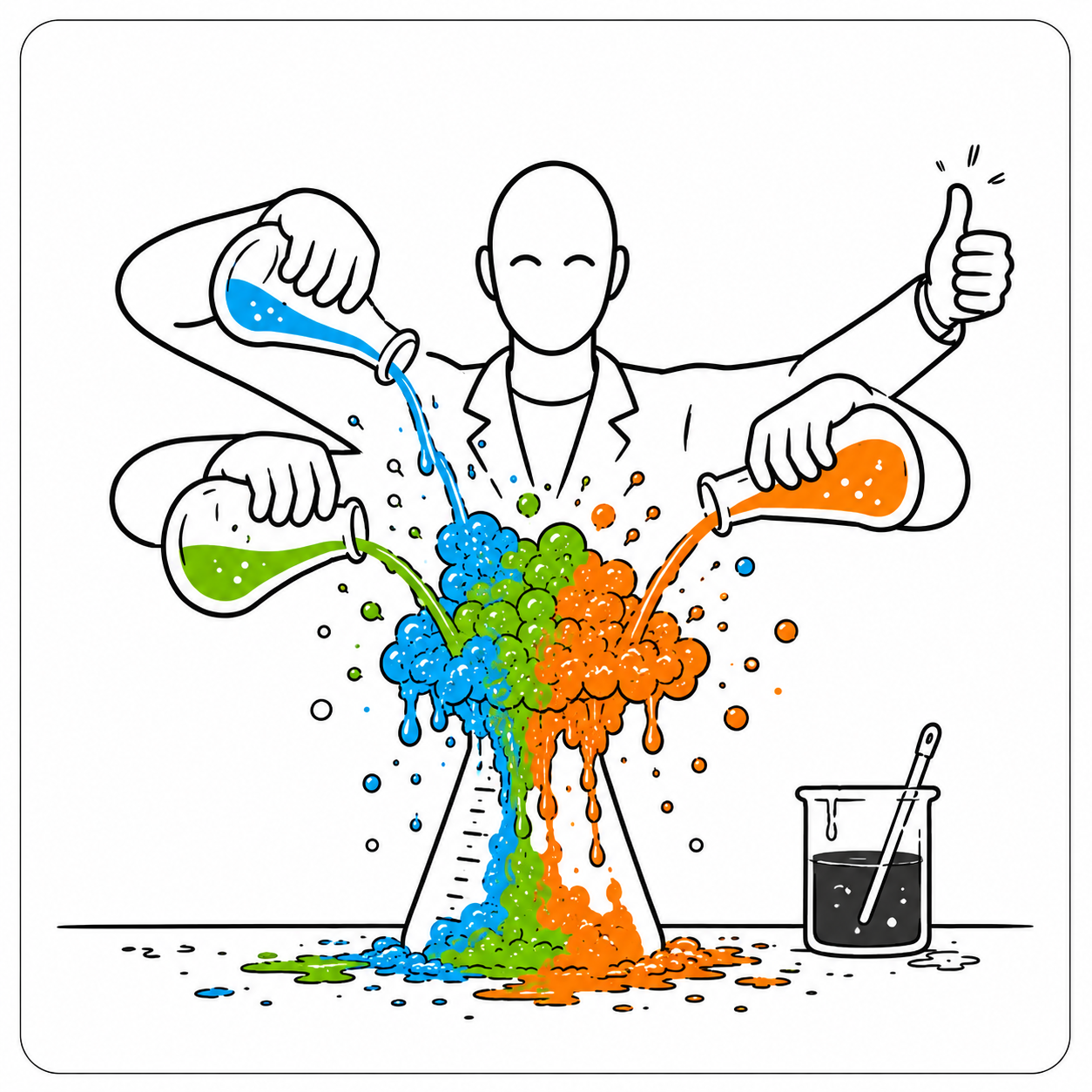
Most students I had, and colleagues I worked with, didn’t really struggle with writing code. They struggled with a lack of structure and direction. They struggled with deciding what to do next.
And there are good reasons for that. Computer science moves incredibly fast. Languages evolve. Packages change. AI models appear almost weekly. The tool you learned about yesterday can be outdated tomorrow.
But once you develop that mindset of process over technique, your value shifts from “the person who knows method X” to “the person who knows how to solve problems.”
That flexibility gives you independence. That’s what I want for you.
AI changed everything. And almost nothing.
Artificial intelligence has transformed the way I work. And what I teach.
When I think back to learning my first programming language (Scheme – but why is the only thing I can ask…), I mostly remember syntax errors, and forgotten arguments. That was simply part of learning.
Today, beginners have an assistant that can write working code in seconds. This changes how we write code, but not how we solve problems.
AI has not replaced understanding. It hasn’t replaced judgement. And it certainly hasn’t replaced curiosity.
You still need to define the problem, decide whether the proposed solution makes sense, and recognise when something has gone wrong.
In other words, you still need to pilot the whole thing. The difference is that you can now delegate much of the mechanics to AI and spend more time on what actually matters.
The same happened to me as a teacher. For years, I was teaching syntax and lists of functions because students had no alternative. Today, AI can take care of most of that.
That gives me the freedom to spend far more time teaching what I always considered the most interesting part of data science: how to think with data.
That also means my courses have changed. I spend far less time teaching syntax and individual functions than I used to. Programming languages are tools, and tools evolve. The principles behind them don’t. Once you understand data structures, reproducible workflows, and how to formulate a good question, moving between packages or even programming languages becomes surprisingly straightforward.
Slow at the beginning. Faster at the end.
One of the biggest surprises for newcomers is that experienced data scientists often don’t start by writing code. They start by thinking.
Most of the important decisions happen before the first line of code.
- What is the question?
- Do we actually have the data?
- Can those data answer the question?
- What assumptions are we making?
Only once those questions have good answers does it make sense to pick methods, packages, and programming languages.
Once the foundations are solid, coding becomes surprisingly straightforward. The path is clear, every step has a purpose, and the tools become exactly what they should be: tools.
That’s the rhythm I try to teach.
Slow at the beginning. Faster at the end. That’s more than a more efficient workflow. It’s also a calmer one.
Things I don’t teach
- I don’t teach people to memorise syntax. I want you to remember concepts.
- I don’t teach recipes that only work in one situation. I want you to understand processes.
- I don’t teach blind trust in AI. I want you to understand why its suggestion makes sense.
- And I don’t believe there is a single “correct” workflow that applies to every project. There are many ways to go from A to B, and the best way is the way that is the easiest for YOU based on your current skillset.
Good data science depends on judgement.
Judgement comes from understanding.
Everything else can be looked up.
Want to learn together?
This philosophy reflects how I design my workshops, in which the goal is to help people become more independent with their day-to-day data work.
Whether I’m teaching a public workshop, designing training for a research institute, or working with a small team, the objective is always the same: help people think more clearly about data so they can tackle new problems with confidence.
That’s the philosophy behind DataSharp Academy.
If that philosophy resonates with you, I’d be delighted to work with you or your organisation. I already have a collection of workshops covering many aspects of data science, but I’m equally happy to design one around your questions, datasets, and objectives. So let’s talk and see what can be done.
I hope we’ll get the opportunity to learn together.
— Manuel